


Publication ethics is the foundation of scientific integrity. Compliance with its principles and norms will ensure the stable development of science and trust in the results of work. In addition, compliance with the principles of publication ethics is a prerequisite for scientists seeking to disseminate the results of their research. What is publication ethics? What are its basic principles? Let's have a look in our article.
.jpg)
What is publication ethics?
Publication ethics is a set of norms, rules, and standards that regulate the behaviour of authors, reviewers, editors, and publishers in the creation, dissemination, and use of scientific works. Compliance with these norms will ensure the reliability and transparency of research results.
The fundamental document for the formation of publication ethics is the Committee on Publication Ethics (COPE) document: “Guidelines on Good Publication Practice”, which regulates issues such as conflicts of interest, the peer review process, plagiarism, etc. Another important document is the “Principles of Transparency and Best Practice in Scholarly Publishing”, which sets out recommendations for ethical and transparent publication processes. It is important that every peer-reviewed scientific journal adheres to the principles set out in these documents.
Publication ethics standards must also be observed by the editorial boards of scientific journals, including the standards specified by COPE.
Why are scientific publication ethics necessary?
In the context of the constant development of science, the growth in the number of scientific publications, and competition among scientists for attention to their work, compliance with publication ethics is a kind of marker of research quality. Publication ethics are necessary to:
- prevent plagiarism
- ensure transparency in the peer review process
- respect the rights of authors and research participants
- preserve the reputation of the author and the scientific journal
The main task of publication ethics is to maintain high standards in the academic publishing sphere at all stages – from the submission of an article to a scientific journal to its indexing.
Major violations of publication ethics
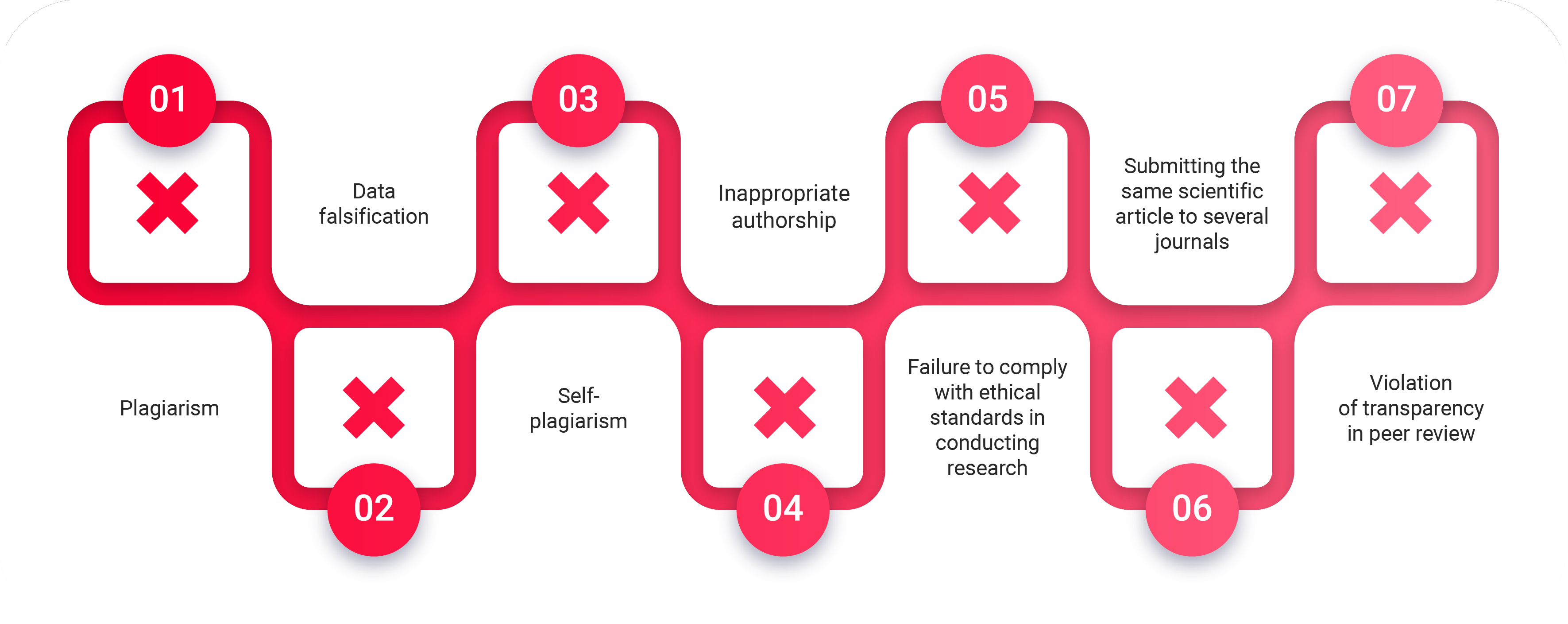
1. Plagiarism
Plagiarism is the appropriation of another person's work in any form (a work, invention, discovery, etc.) or the use of part of another person's creative work in one's own work without mentioning the author. Plagiarism can be either direct copying of text from another work or paraphrased information without proper attribution to the author. A high level of plagiarism in a work undermines trust in the researcher and violates copyright. This can lead to the retraction of an article, delayed publication, or even legal action.
2. Fabrication and falsification of data
Fabrication is the invention of non-existent data or results. Falsification is the deliberate distortion or fabrication of existing data in order to achieve a desired result. Both practices are gross violations of publication ethics. They threaten the reputation of the author as well as the scientific community that operates with false data.
3. Self-plagiarism
Self-plagiarism is the re-publication of previously published research results. Reusing data without citing the original source negatively affects the originality of the article, as the editorial board will identify any signs of self-citation when reviewing the work. In addition, such actions cast doubt on the scientific activity of the researcher and the expansion of their knowledge. On average, the acceptable percentage of self-citation in a work is 10-12%.
4. Inappropriate authorship
Inappropriate authorship involves including individuals who did not contribute to the work in the list of authors, or conversely, excluding those who made a significant contribution to the research. Such actions violate the fair contribution of each scientist to the research, as authorship should reflect the actual contribution to the preparation of the work.
5. Failure to comply with ethical standards in conducting research
This point covers a wide range of violations, including the lack of informed consent from participants to use the data obtained, experiments on animals and humans, etc. Violation of ethical standards at the research stage calls into question the legitimacy of the data obtained and violates the basic principles of respect for human beings and nature.
6. Submitting a scientific article to several journals
Resubmitting an article to several journals is a gross violation of the principles of publication ethics, which can lead to the withdrawal of the publication and negatively affect the author's reputation. Duplication of work can be quickly detected using automatic verification systems, which will lead to serious problems and a loss of trust in the scientist.
7. Violation of transparency in the review process
Reviewing should be an objective, impartial, and confidential process. In addition, the use of someone else's data for one's own purposes or the submission of a deliberately biased review is considered a violation. Such actions undermine confidence in the review system and call into question the quality of published research.
Without compliance with the basic principles and rules of publication ethics, publication of research is impossible. When preparing an article for submission to a scientific journal, carefully read the publication ethics provisions, which can be found on the official website of the publication and on the “Publication Ethics” page. Compliance with these requirements will help you build an image as a scientist who is responsible for the dissemination of their own research results and will ensure the editorial board's trust in your work.
Scientific Publications values the trust of its clients and guarantees high compliance with publication ethics. Since 2016, we have been providing quality services to scientists from around the world. Our reputation is confirmed by successful scientific projects, memoranda signed with universities and scientific organisations, as well as numerous reviews from satisfied customers. To learn more about the terms of cooperation, fill out the form below and our manager will contact you shortly. Together towards successful publication!


